
Overview of the SFPA
Organisational structure of the SFPA (relating to seafood safety)
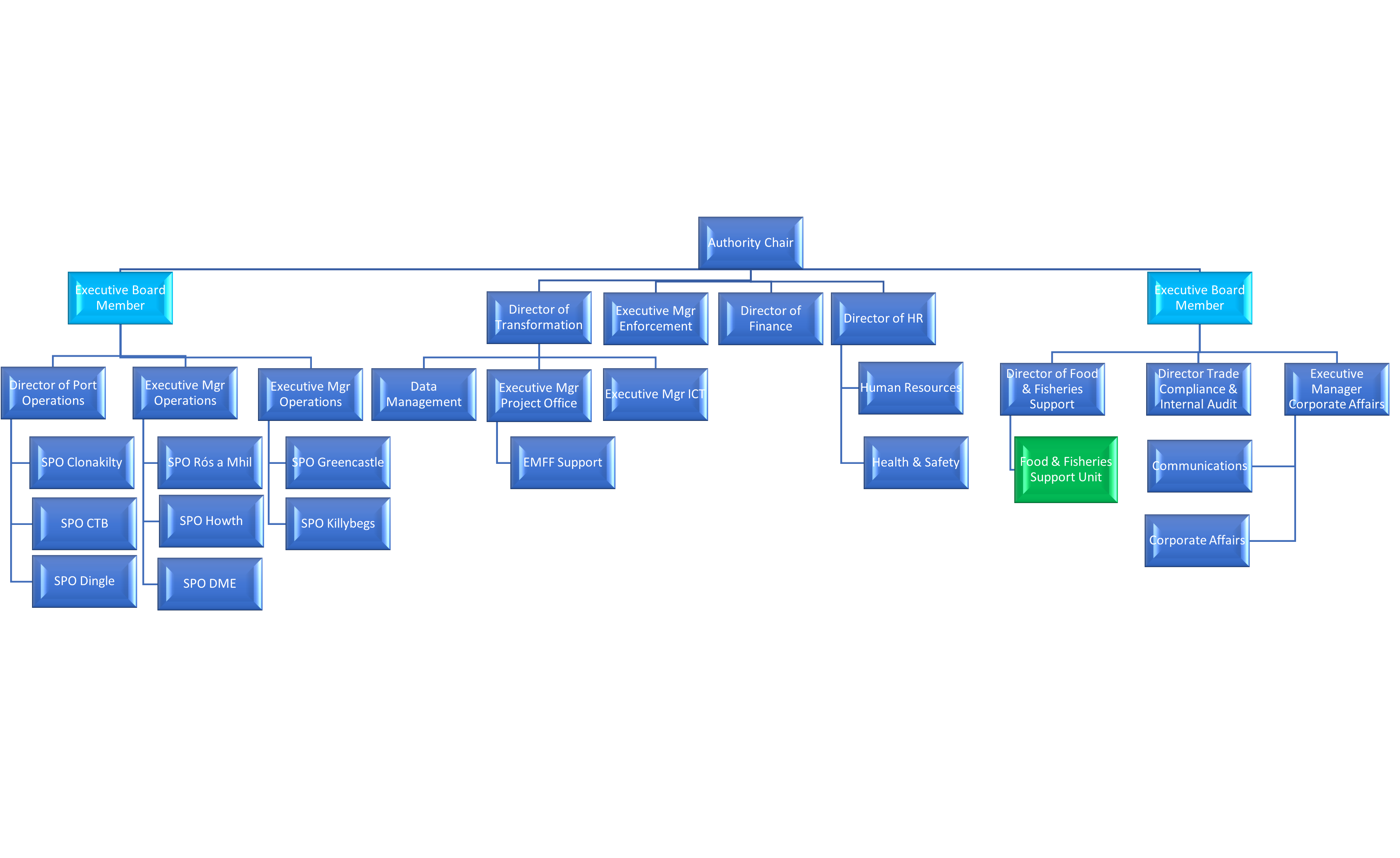
The Sea Fisheries Protection Authority (SFPA) was established under the provisions of the Sea-Fisheries and Maritime Jurisdiction Act (SFMJ Act) 2006 with the statutory remit to enforce national and European Union (EU) regulations on sea-fisheries conservation and seafood safety. Section 44(4) of the SFMJ Act 2006 gives the SFPA power to enforce food safety law in lieu of the Minister for the purposes of the Food Safety Authority of Ireland (FSAI) Act 1998. Subject to the SFMJ Act 2006, the SFPA is independent in the exercise of its functions.
.png "map-landing-places-(1).png") The SFPA is an official agency of the FSAI, with a service contract agreement, which outlines the agreed level and standard of seafood safety activity that the SFPA performs as a competent authority. The SFPA headquarters is in Clonakilty, Co. Cork.
The SFPA is an official agency of the FSAI, with a service contract agreement, which outlines the agreed level and standard of seafood safety activity that the SFPA performs as a competent authority. The SFPA headquarters is in Clonakilty, Co. Cork.
The SFPA has responsibility for the implementation and enforcement of national and EU legislation, which deals with health conditions for the production and placing on the market of fish, shellfish, and fisheries products. The SFPA carries out official controls of seafood at all stages of production, processing, and distribution with the exclusion of fin fish farms and retail establishments.
There are the Board members of the Authority, the Management Board, the Senior Management Team leading specialised units. SFPA’s operations is led by one Director of Operations, Senior Port Officers (SPO), 74 Sea Fisheries Protection Officers (SFPOs), and administrative staff.
The SFPA has a number of support units in headquarters that supports operational duties. The Food and Fisheries Support Unit (FFSU), which is one of the specialised units within the SFPA, headed by the Director of Food & Fisheries Support, is based at the headquarters. The primary function of the food safety group of the FFSU is to support and co-ordinate the food safety regulation activities of the SFPA. In carrying out it’s functions, the FFSU works in collaboration with other units such as the Trade and Imports unit, the Data unit and the Legal Case Management. The SFPA also have port offices around the coast. Senior Port Officers (SPOs) have the responsibility for the running of the port offices.
Areas of official controls as defined by Art 1(2) of Regulation (EU) 2017/625
- Article 1(2)(a) Food (production, processing, distribution)
- Article 1(2)(a) Food contact materials
- Article 1(2)(e) Animal by-products
- Article 1(2)(i) Organic production & labelling.
Delegation of official controls
The SFPA do not delegate any official control tasks to delegated bodies in accordance with Article 28 of Regulation (EU) 2017/625.
Scope of responsibility of the SFPA for the official control of food
The SFPA has responsibility for the implementation and enforcement of national and EU legislation, which deal with food safety conditions for the production and placing on the market of fish, shellfish and fisheries products. The SFPA carries out official controls of seafood at classified production areas, harvesting, movement, processing, wholesale and distribution, with the exclusion of retail establishments. The legislation enforced by the SFPA includes general food law, official controls, food hygiene, technical guidance on import control, labelling, presentation and advertising of foodstuffs, additives and flavourings, contaminants, residues of veterinary medicines, animal remedies, microbiological criteria, marine biotoxins, zoonoses and food contact materials. The SFPA is responsible for approving establishments that handle fish and shellfish under national legislation implementing Regulation (EC) No. 853/2004. The SFPA maintain a national list of approved establishments where they carry out official controls.
The SFPA also holds a register of importers of fish and fishery products from third countries. The SFPA responds to queries from importers and provides advice in relation to what legislative requirements need to be met when importing fish and fishery products. On request, the SFPA provides technical advice to the Department of Agriculture Food and Marine (DAFM) border control post (BCP) officers in relation to imports of fish and fishery products. DAFM is responsible for official controls of live fish imports.
Official Controls
Risk categorisation and frequency of official controls
In accordance with EU Regulation 2017/625, the SFPA prioritises official controls based on risk assessment. This ensures that more official control activity is undertaken at establishments that pose a greater risk to food safety compared to establishments that pose a low food safety risk.
Risk assessments are completed for all approved establishment when initially approved/recommended for approval. Risk assessments are conducted on all approved establishment and fishing vessels at least annually (or more frequently if the need arises, e.g., significant non-compliance detected, food fraud suspected, change in activities). The risk assessment determines the inspection frequency.
To support this processes, the SFPA has a documented risk assessment procedure for official controls. This code of practice outlines how an approved establishment including freezer and factory vessels and establishments requiring approval may be categorised according to risk and how the appropriate frequency of official control inspections for that establishment may be determined. The risk categories are High, Medium or Low and Ready to Eat or Non-Ready to Eat. Risk assessments must be reviewed at least annually, or more frequently if the need arises.
Microbiological sampling plans are maintained for all classified shellfish production areas. These plans record the species, sample location code, position of sampling points and frequency of sampling. The sampling plans are the basis of the microbiological monitoring programme of classified production areas and the results are used in the annual review of classifications. Further information on sampling frequency is available in the Code of Practice for the Classification and Microbiological Monitoring of Bivalve Mollusc Production Areas in Ireland.
 Methods of official control
The SFPA’s food safety control plan is produced by the FFSU and authorised and approved by the SFPA Authority Members. This plan provides a baseline framework for food safety work to be carried out by the SFPA annually. It is based on legislative requirements, requirements of their service contract with the FSAI and SFPA sampling plans. The control plan is available on the SFPA intranet. The food safety control plan is a rolling document, which is reviewed and updated during the course of the year. Each new revision is sent to the FSAI via email, as per the service contract.
The SFPA carries out official controls on risk basis in accordance with the SFPA’s annual food safety control plan. The food safety control plan covers the range of control methods and techniques outlined in Article 14 of Regulation (EU) 2017/625, including verification, inspection, audit, sampling and analysis, monitoring and surveillance. The SFPA food safety control plan provides an overview of the areas where SFPA food safety official controls take place and the types of official controls.
Recording of official controls
When official control inspections/audits are performed, SFPOs typically complete a checklist and/or inspection report documenting the outcomes. When official control samples are taken, SFPOs complete a sample request form. This is submitted to the laboratory, and a copy is maintained by the SFPO for port office files. The resulting lab cert is reviewed and, if follow up is required, this is actioned and documented.
Inspections/audits, sampling activities and outcomes are recorded by SFPOs on the official agency premise inspection database (OAPI), a web portal operated by the FSAI. The SFPA’s food safety control plan requires that all records should be entered on OAPI within two weeks of the end of each month. Both SFPA and FSAI have access to OAPI data. SFPA dashboard reports are generated and circulated by the FSAI data team to the SFPA, based on data inputted into OAPI by the SFPOs. Thes e reports use a traffic light colour coding system to indicate how actual inspections recorded on OAPI compare with inspection targets. These dashboards are available to SFPOs on SFPA Connect. Ports also send quarterly reports of all official controls carried out during that Quarter.
Auditors, including European Commission Santé F auditors, are invited to view entries on OAPI including inspection reports, completed sample request forms and other documentation if required during audits.
National control plans
The SFPA is involved with the following specific national control plans:
- National residues control plan

- Microbiological sampling programme
- Chemical sampling programme
Other control plans that the SFPA are involved in include:
- Microbiological Monitoring of Bivalve Mollusc Production Areas (Classification sampling)
- Monitoring of Marine Biotoxins in Bivalve Molluscs from Production Areas
- Phytoplankton Monitoring of Bivalve Mollusc Production Areas
- Shellfish water directive sampling
- Histamine analysis of fishery products from histidine rich species
- 4-Hexylresorcinol analysis of crustaceans
- Heavy metal analysis of fishery products
- Tin in canned fishery products
- Polycyclic aromatic hydrocarbons (PAHs) in smoked fish/fishery products
- Carbon monoxide (CO) analysis in tuna and swordfish
- Nitrates and nitrites in tuna
- Perfluoroalkylated substances (PFAS) in fin-fish
- Fin-fish speciation (using DNA analysis)


Resources and Facilities
Staffing resources
The staffing resources that the SFPA provide for the official control of foodstuffs are included in the service contract between the FSAI and the SFPA. Staffing figures are reported annually in the SFPA annual report, which is submitted to the FSAI as per the service contract. In 2020 the SFPA had 47 posts filled by whole-time equivalents in the area of food safety.
Ongoing training needs of staff are identified on an annual basis as part of performance management and development system completed by all staff. Findings from audits and official controls are also taken into account in th e planning of training. Plans are implemented by the SFPA central headquarters. Training plans are a mix of internal training and external training.
The FSAI delivers cross-agency training which SFPA inspectorate attend. SFPOs are also encouraged to undertake e-learning courses provided by the FSAI through the Safeynet website for official agency staff. SFPA staff members regularly attend face to face European Commission funded training courses - Better Training for Safer Food. SFPOs are also encouraged to attend any relevant webinars, for example, webinars run by the Safefood Knowledge Network.
All training records are maintained centrally. Staff members are asked to complete evaluation forms upon completion of training. Returned forms are reviewed and retained centrally.
Laboratory resources
The SFPA uses accredited designated official laboratories for the analysis of SFPA official control samples. These laboratories have been designated as Official Laboratories by the FSAI in line with Article 100(1) of Regulation (EU) 2017/625. Sampling consumables are generally provided by laboratories in advance of sampling.
IT resources
The SFPA use the FSAI centralised OAPI database to record information regarding their official control responsibilities.
Other resources
The SFPA staff have access to refrigeration, freezer and storage facilities where required. SFPA staff also have access to necessary equipment including personal protective equipment, temperature probes, cooler boxes, sampling boxes etc.
 Office facilities
SFPA headquarters (HQ) is in Clonakilty, Co. Cork.
Regional port offices are located around the coast as follows:
- Castletownbere, Co. Cork
- Dingle, Co. Kerry
- Dunmore East, Co. Waterford
- Greencastle, Co. Donegal
- Howth, Co. Dublin
- Killybegs, Co. Donegal
- Ros a Mhíl, Co. Galway
- Clonakilty Port, within SFPA HQ
Regulation (EU) 2017/625 (General Obligations)
Article 5(1)(a) Effectiveness and appropriateness of official controls
The SFPA has a framework of official controls to be carried out in the form of the food safety control plan. This plan ensures that all appropriate official controls are carried out in accordance with Regulation (EU) 2017/625. The FSAI’s data team provides SFPA dashboard reports on a regular basis to reflect the official controls completed and inputted into OAPI by SFPOs versus targets. Furthermore, more detailed OAPI inspection summaries are produced.
The database tools are provided to assist managers in monitoring and planning official controls during the year. This information also assists in identifying where additional support may be needed to achieve targets and to identify other work that could potentially impact on delivery of the programmed work. Internal audits within the SFPA also help to ensure the effectiveness and appropriateness of official controls.
Other means of verifying effectiveness of official controls are as follows:
- Use of Dashboards: SFPA monthly Dashboard Reports are circulated to ports and are used to monitor number of inspections carried out versus targets.
- Business Plans- each port has a business plan with required food safety and fishery control outputs. The plan contains official control categories and port Key Performance Indicators. Updates are submitted on a quarterly basis by the ports to head quarters
- Each approval inspection report completed by an SFPO is reviewed and signed off by an SPO. The report in turn is reviewed by the Director of Food and Fisheries Support before the Approval is issued.
- Food Incidents, their follow up and close out is reviewed on a monthly basis at SFPA head quarters
All activities are undertaken impartially and are structured and managed to safeguard impartiality in accordance with Article 5 (1) of Regulation EU 2017/625.
Article 5(1)(b) Consistency in the delivery of official controls
To ensure consistency in the delivery of official controls, a comprehensive training programme is delivered to all new SFPOs along with practical mentoring by experienced staff. Experienced staff also receive ongoing training throughout their career. In addition, the SFPA has a comprehensive suite of inspection checklists and guidance notes developed and updated in accordance with a documented control system to help ensure consistency in delivery of official controls.
Article 5(1)(c) Ensuring staff performing official controls are free from conflicts of interest
Section 57 of the SFMJ Act 2006 places an on-going, real time disclosure of interest’s obligation on all Members of the SFPA, SFPA staff, consultants, advisors or other person engaged by the SFPA in the event that they, or a connected relative has/have a beneficial interest in, or are material to, any matter which falls to be considered by the SFPA. In order to facilitate awareness of this ongoing obligation the SFPA issues an annual reminder to all staff in relation to their Section 57 obligations. A disclosure should be made any time a conflict arises for any individual, a designated form exists for staff to complete when making a declaration of conflict of interest.
Furthermore, in compliance with the requirements of Section 56 of the Sea-Fisheries and Maritime Jurisdiction Act 2006, and corporate governance obligations, and in order to ensure the highest standards of probity and accountability, the SFPA operate a Code of Conduct (Code) that sets out the minimum standards required of Authority Members and all employees of the Sea-Fisheries Protection Authority, particularly with respect to controls on interests and ethical behaviour.
Article 5(1)(d) Access to adequate laboratory capacity
Dedicated staff members within the SFPA’s FFSU liaise between the laboratories and SFPA port offices to ensure that SFPOs have access to adequate lab capacity. Annual programmes are organised for each port office. Sample numbers and testing parameters are based on the number of food business operators supervised by a particular port office and the business types. Where requirements for additional capacity are identified, FFSU staff liaise with SFPA offices, official laboratories and, if necessary, the FSAI, to ensure that capacity is developed. This can involve requesting that laboratories introduce new methods, where necessary.
Article 5(1)(e) Access to suitably qualified and experienced staff
The SFPA has a highly qualified inspectorate which enables official control staff to perform multi-faceted front-line roles in seafood safety. Minimum qualification required for inspectorate is a national diploma, level 7, in a discipline relevant to the work of the SFPA. For example, qualifications or competency in marine, fisheries, food, environmental science, data, law and enforcement. Staff carrying out official controls come from diverse backgrounds and hold various qualifications. Current staff have extensive qualifications, such as Diploma, Degree, Masters & PhD qualifications. New inspectorate follow a standardised comprehensive induction training and are subsequently mentored by experienced operational staff and verified by the Senior Port Officers. New inspectorate are monitored at the ports to ensure staff are gaining sufficient experience prior to being issued a service card.
Staff undergo regular refresher and awareness training. An annual training plan is scheduled which involves both internal and external training. The training plan is based on training needs identified by staff on an annual basis.
Article 5(1)(f) Access to adequate facilities and equipment
See Resources and Facilities section.
Article 5(1)(g) Ensuring staff have adequate legal powers to perform official controls
The SFPA has extensive legal powers to carry out official controls under FSAI Act 1998, the SFMJ Act 2006 and S.I. 22/2020 European Union (Food and Feed Hygiene Regulations) 2020.
Article 5(1)(h) Ensuring food business operators cooperate with staff performing official controls
The SFPA promotes compliance, verifies compliance and where necessary using its powers enforces the relevant EU food legislation across the seafood chain. The SFPA has extensive enforcement powers under the FSAI Act 1998, the SFMJ Act 2006 and S.I. 22/2020 European Union (Food and Feed Hygiene Regulations) 2020. The SFPA website contains information on seafood safety and molluscan shellfish safety that can be accessed by food business operators. In the event of an operator not co-operating the appropriate enforcement would be taken.
The SFPA have also published a Code of Conduct in relation to SFPA inspections of fishing vessels. The Code of Conduct was produced in collaboration with the Sea-Fisheries Protection Consultative Committee. It sets out the general principles and standards which must guide the professional activities and conduct of Sea-Fisheries Protection Officers of the SFPA, vessel masters and their crew during inspections.
The Code of Conduct also details the matters that can be examined during a port inspection in relation to fisheries and food legislation as well as electronic monitoring requirements. These include registration and food safety documentation, catch composition and quality assessment as well as checks on a vessel’s fishing gear. The role of the SFPA along with Fishing Vessel Operators and their crews in fulfilling their national and EU obligations during inspections is also covered under the Code. Furthermore, it sets out the outcomes following the completion of an inspection.
Relationships, Memoranda of Understanding and Service Level Agreements with other Competent Authorities
In accordance with their service contract with the FSAI, the SFPA shares responsibility for official controls with DAFM in the following areas:
Finfish aquaculture sites
Hygiene, animal remedies and animal by-products official controls on finfish farms are carried out by DAFM Veterinary Inspectors (VIs) on behalf of the SFPA as per agreement under the SFMJ Act 2006, Chapter 5 section 43 (2)(b). The SFPA and DAFM work together to ensure the implementation of these regulations in finfish farms. As per the agreement:
- DAFM VIs are responsible for routine inspections at the finfish farms,
- DAFM VIs are responsible for follow-up investigations based on issues and/or non-compliances arising from routine inspections,
- SFPA is responsible for follow–up investigations based on non-compliances arising from sampling under the national residues monitoring programme.
In the event of a non-compliance arising within the national residues monitoring programme, SFPA staff can use the SFPA’s internal guidance note on Action to Take in the Case of a Non-Compliant Result within the Residues Monitoring Programme for Finfish Aquaculture in Ireland.
Official Controls of certain substances and residues thereof
Programmed, pre-planned surveillance and official controls in relation to finfish aquaculture sites are the responsibility of DAFM.
The SFPA has responsibility for responding to non-conformances detected as part of the national residues control plan, where those non-conformances relate to fish or fishery products.
Animal by-products
It is the responsibility of DAFM to approve or register and implement animal by-product official controls at animal-by product plants in Ireland. It is agreed that DAFM in conjunction with SFPA staff will approve/register animal by-product operators (aquatic animals only) and that the SFPA will undertake to carry out on-going official controls at set frequencies. The SFPA will liaise with DAFM on relevant aspects of these inspections as necessary including non-compliances. Official control sampling will be carried out as necessary at these plants.
The responsibility for enforcement action under the animal by-product legislation lies with DAFM. However, if enforcement action is required at the above plant types, SFPA staff may assist DAFM in terms of providing technical expertise and documentary evidence along with corrective and preventive action follow-up. It is agreed that as the SFPA have the local supervisory role, the business operator should contact and deal with the SFPA in the first instance, and the SFPA will subsequently liaise with DAFM, and if DAFM wish to liaise with the business operator, this will be channelled through the SFPA. This is not only to provide clarity in respective roles of each agency but also to be fair and transparent with the business operator. When the approval or registration of any plant/establishment/business operator covered by this joint agreement falls due for renewal, DAFM will contact the SFPA in advance of the expiry date to get a recommendation to renew the approval or registration and to look for any changes that may be desired to the conditions of approval.
Border control posts
The SFPA is the competent authority for public health conditions for fish and fishery products and illegal, unreported and unregulated fishing. DAFM is the competent authority for public and animal health conditions for animals and products of animal origin other than fish and fishery products and the competent authority for all controls and operate the BCPs.
DAFM VIs are responsible for the administration of the veterinary check’s regime for products of animal origin including fishery products; these checks, including labelling and traceability checks, are carried out at approved BCPs (Dublin Port, Rosslare Port and Shannon Airport). The SFPA provides technical support to veterinary officers at BCPs when required. The SFPA’s FFSU liaises with SFPA port offices should follow-up be required on imports arriving at SFPA supervised establishments.
Communication procedures
The SFPA have the following measures in place to ensure effective and efficient communication:
- Within the SFPA
- A dedicated communications team to ensure effective and efficient communication within the SFPA
- Intranet- an internal communications portal accessible to all staff
- Internal newsletter
- Weekly all staff meetings, divisional and cross-divisional
- With other competent authorities and the FSAI
- Formal communication:
- Quarterly bilateral liaison meetings with SFPA Management and the FFSU
- Regional workshops with SPOs and SFPOs
- Trilateral meetings with the FSAI and the MI
- Cross-agency meetings with other competent authorities
- Participation in the Molluscan Shellfish Safety Committee
- Working groups
- Collaboration in development of guidance documents
- Semi-formal communication:
- Regular email contact
- Informal communication:
- Phone calls
- Formal communication:
Documented Procedures
Availability of documented procedures to SFPA Staff
The SFPA has comprehensive documented procedures in place to assist staff in carrying out all official control activities. Documents include guidance notes, standard operating procedures, checklists, inspection report templates and enforcement templates.
The SFPA has an Intranet called SFPA Connect, which is an internal communication portal where all relevant up-to-date documented procedures are accessible to staff performing official controls and to staff in SFPA HQ. Furthermore, the SFPA produces an annual food safety control plan, which outlines the various official control types and provides hyperlinks to the relevant documented procedures. All SFPA food safety documents for SFPOs (Guidance Notes, Standard Operating Procedures, Codes of Practice, Inspection Checklists, SFPA Dashboard Reports, OAPI Inspection Summaries, and other documentation) which relate to the different food safety official controls activities can be accessed on the intranet, SFPA Connect, and through hyperlinks in the current Food Safety Control Plan.
A document control system is in place to ensure that all documents have a unique document code, version number and issue date. There is a specific procedure in place for the modification and approval of documents prior to issue. SFPA staff members are informed of new documents and updated versions of existing documents by email and through announcements on SFPA Connect.
Availability of documented procedures to the FSAI & Auditors
The SFPA has formal bilateral meetings with the FSAI on a quarterly basis. The FSAI is informed of new documents and updated version of existing documents and provided with copies if requested.
Prior to and during an audit, documented procedures are made available to the auditors. Documentation is supplied to the Commission as requested, for example, in advance of Santé F audits.
Reviewing & updating procedures
A document control system is in place to ensure that all documents have a unique document code, version number and issue date. Where a need to update a document is identified, e.g., due to a legislative change, there is a specific procedure in place for the modification and approval of documents by the FFSU management prior to issue. The reason for the modification is documented as is the change made. The updated document is uploaded on SFPA Connect. SFPA staff members are then informed of the updated version by email and through announcements on SFPA Connect.
Audit
Internal audit
The SFPA has a dedicated internal audit division which implements an annual programme of internal audits. Further information is available on their website.
External audit
The SFPA has a service level agreement with the FSAI and is subject to audits by the FSAI. In addition, the SFPA is subject to audits by the Commission (Santé F audits), and third countries.
For further information on any matter raised on this page, or to suggest a correction, contact mancp@fsai.ie